
Thanks to the long holiday, more people traveled, giving Vietnam’s tourism industry a major boost at the start of the new year. Statistics released by the Vietnam National Authority of Tourism on Feb. 22 showed that the country served around 14 million visitor trips from Feb. 14 to 22, up 12% from the same period last year. Nationwide hotel occupancy averaged 70% during the period, with many destinations reaching 90%-95% occupancy, including Phu Quoc, Sa Pa, and Phan Thiet.
The extended break also drove demand for package tours. A quick survey by VnExpress found that the number of Vietnamese booking Tet tours through companies such as Vietravel, Trang An Travel, Du lich Viet, and Vietluxtour increased by 20-30% year-on-year. The first and second days of Tet were the peak departure dates. Domestic tours continued to dominate, with visitor numbers rising 15-20% compared with Tet 2025.
Dr. Pham Ha, CEO of LuxGroup, said holiday tour bookings were 1.5 to 2 times higher than on regular days.
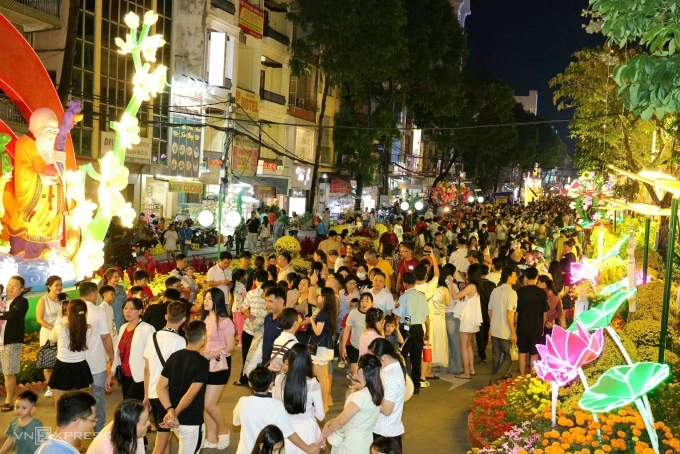
Residents and tourists visit an artistic flower street in Can Tho during Tet 2026. Photo: Doan Huy Phong.
The long holiday also gave many provinces and cities a chance to “cash in,” with tourism revenue exceeding VND1 trillion in several localities over the 9 days. Ho Chi Minh City posted the highest total revenue nationwide, at more than VND12.15 trillion, followed by Hanoi, Da Nang, Ninh Binh, Lao Cai, and Hue. According to the tourism authority, this year’s Lunar New Year marked “a vibrant tourism season with impressive growth.”
Pham Hai Quynh, head of the Asia Tourism Development Institute (VTI), said the 9-day break was a strategic boost that helped change consumer habits in tourism.
The longer holiday allowed travelers to choose tours lasting 4-6 days rather than rushed 1-2-day trips. Visitors not only traveled but also used more services such as spas and high-end dining, while increasing shopping spending.
Tourists sunbathe in Khanh Hoa during Tet. Photo: Bui Toan.
Not only Vietnamese travelers, but Tet Binh Ngo 2026 also became a golden period for attracting international visitors, who tend to favor long holidays in Southeast Asia. In many localities, the number of international visitors was equal to or nearly equal to that of domestic visitors.
In Da Nang, international arrivals reached 510,000, accounting for nearly 50% of the city’s total 1.1 million visitors. Hue showed a similar ratio, welcoming 240,000 international visitors out of more than 480,000 total. Other provinces and cities with high numbers of international visitors included Ho Chi Minh City, Ninh Binh, and Hanoi.
Top localities receiving the most international visitors nationwide
(Source: Provincial Departments of Tourism)
- Da Nang
- Ninh Binh
- Quang Ninh
- Hue
- Hanoi
- Ho Chi Minh City
- An Giang
- Lam Dong
Mr. Pham Ha said that, in addition to these gains, the industry also needed to re-examine unresolved issues during holiday periods, such as overcrowding, service quality not matching prices, and prolonged traffic congestion at some popular destinations.
On Feb. 20, the management board of the Trang An Scenic Landscape Complex announced it was overwhelmed and had stopped selling additional tickets. Its online ticketing system was also suspended during Tet, and many visitors who came to buy tickets in person had to queue for hours, with some giving up midway.
About 300 km from Hanoi, Ha Giang was also packed with tourists from the afternoon of the third day of Tet. On the morning of the fourth day, long traffic jams were reported at Tham Ma Slope, Ma Pi Leng Pass, and the Nho Que River area. Many tourists had to change their itineraries, forfeit attraction tickets, and urgently look for alternative accommodations due to traffic congestion.
“We need to care about tourists’ feelings—whether they truly enjoyed and felt satisfied during this holiday,” Mr. Ha said, referring to destinations being “overrun” during Tet.
Localities could use mobile data to forecast visitor flows at hot spots. When destinations reach 80-90% of capacity, authorities should have remote traffic distribution systems or advise tourists to switch to nearby attractions.
To reduce pressure on core zones, they should develop community tourism sites and craft villages around central areas. Authorities should also arrange park-and-ride lots and use electric shuttle vehicles to bring visitors into town centers, minimizing congestion caused by large vehicles on narrow roads, Mr. Quynh suggested.
In addition to overcrowding, price hikes and the lack of shops open to serve tourists in many provinces and cities also remain difficult issues for the tourism industry.
With more than 10 years of serving international tourists during Tet, Mr. Ha said his company had repeatedly faced difficulties such as labor shortages and shop closures during the holiday.
He explained that many business owners are reluctant to open during Tet because food prices are higher, labor costs are 3-5 times normal rates, and many people prefer to rest during the holiday.
People shop for Tet in Khanh Hoa. Photo: Bui Toan.
To attract visitors and encourage higher spending during holiday periods, Mr. Quynh said the industry needs to focus on the quality of the experience.
Instead of traditional tours, the sector should promote night tours, large-scale live performance shows, and all-night food streets to extend visitors’ spending time.
It should also develop integrated apps covering ticket booking, digital maps, and cashless payments at all destinations, so spending becomes “fast and convenient.” Travel companies should partner with airlines and hotels to create high-quality service packages at reasonable prices, rather than offering deep discounts that damage brand value.
“For long holidays to be truly successful, localities need to shift from a mindset of attracting large numbers of visitors to sustainable destination management,” Mr. Quynh said.